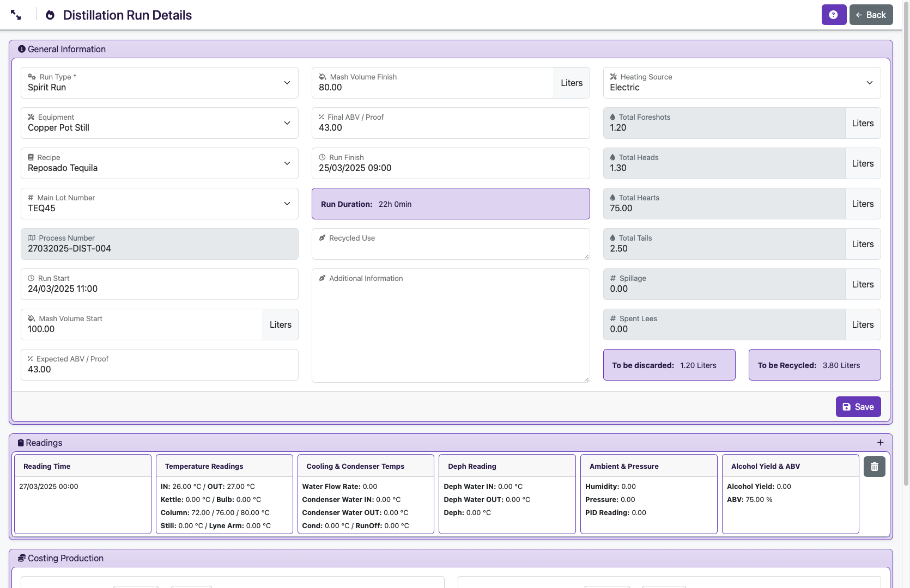
Recipe management in alcohol production is far more than listing ingredients. It is about precision, traceability, and scalability. Whether you are distilling gin with a complex botanical profile or crafting a schnapps with specific sugar and ABV targets, your distillery needs a structured, software-driven approach to manage every aspect of formulation -- from the first test batch to full commercial production.
Building and Scaling Mash Bills
Mash bills -- the grain-based recipes for fermentation -- form the backbone of spirits like whiskey, bourbon, and vodka. Managing mash bills effectively means being able to:
- Create consistent base recipes with defined ingredient ratios
- Scale formulations up or down without altering those ratios
- Track historical changes for R&D purposes or compliance review
With proper mash bill management, your production teams can replicate results reliably while also experimenting with new grain combinations or process adjustments -- without losing sight of what the original recipe specified.
Blending and Flavour Formulas: Consistency in Every Bottle
Flavour-driven spirits -- liqueurs, botanical gins, schnapps -- require tightly controlled blending formulas. These recipes may include natural flavours, distillates, sugar, or acids. Distillery software allows you to:
- Document exact quantities and sequence of additions
- Control sugar content and ABV targets for each product
- Ensure consistency across batches so every bottle matches the intended profile
Once a formulation is dialled in and locked into your system, future production runs stay true to the intended taste without relying on memory or informal notes.
Linking Ingredients to Inventory and Costing
Every ingredient in a recipe should be directly linked to your inventory database. This integration allows for:
- Real-time stock deductions as production consumes ingredients
- Accurate costing based on current raw material values
- Full visibility into usage trends and reorder points
Without this integration, your costing will always lag behind reality -- and production delays from missing ingredients become difficult to anticipate before they happen.
Tracking ABV, Sugar Content, and Allergens
Regulatory compliance and accurate product labeling depend on precise measurement of alcohol by volume, sugar content, and potential allergens. With digital recipe tracking, you can:
- Automatically calculate expected ABV based on fermentation and dilution inputs
- Log sugar additions or concentrations for each product type
- Flag allergenic ingredients across formulations to ensure labeling accuracy
This ensures every bottle that leaves your facility meets both legal requirements and your own brand standards -- in every market you operate.
Version Control: Why It Matters More Than Most Producers Realise
Recipe changes happen constantly in a working distillery -- ingredient substitutions due to supply issues, process tweaks to improve yield, ABV adjustments for new markets. Without version control, it becomes almost impossible to know which version of a recipe was used for a specific batch, or to reproduce a product that performed exceptionally well six months ago.
Liquor Logic maintains a complete version history for every recipe. Each change is timestamped and attributed to a specific user, creating an audit trail that supports both quality investigations and regulatory compliance. You can compare any two versions side by side, revert to a previous version, or branch a new experimental version from an existing one -- without affecting live production records.
Recipe Formulation Questions Distilleries Ask Most
How do you handle recipe variations for the same spirit sold in different markets?
The most practical approach is to maintain a master recipe and create market-specific variants that inherit the core formulation but differ on parameters like final ABV, sugar level, or botanical concentration. Each variant is stored as a separate recipe version linked to the master, so changes to the core process can be propagated to all variants while market-specific adjustments remain independent. This structure also makes it straightforward to produce the correct variant for each batch without confusion on the production floor.
What information should a distillery include in a recipe record for compliance purposes?
At minimum: the recipe name and version number, a complete ingredient list with quantities and units, the expected yield and ABV, the production method (fermentation parameters, distillation cuts, dilution process), any allergens present, and the date of last modification with the name of the person who made the change. For spirits with a defined legal classification, the record should also confirm compliance with the relevant standard of identity -- grain composition for bourbon, geographic origin for Scotch, and so on.
Can recipe tracking software handle co-fermentation or multi-step botanical processes?
Yes -- and this is one of the areas where purpose-built distillery software significantly outperforms adapted generic tools. Liquor Logic supports multi-stage recipes where different ingredients are added at different points in the process -- botanicals added to a base spirit at maceration, for example, or a second fermentation addition for a specific flavour outcome. Each stage is tracked separately with its own ingredient quantities, timing, and quality checkpoints, giving you full traceability across the entire process.
Conclusion
Effective recipe tracking is not a luxury -- it is essential for quality control, cost management, and compliance. By using dedicated distillery software to manage mash bills, flavour formulations, and ingredient data, producers build the consistency and traceability needed to scale confidently. Whether you are refining a new gin recipe or standardising your schnapps production, precise formulation tools are non-negotiable for any serious operation.