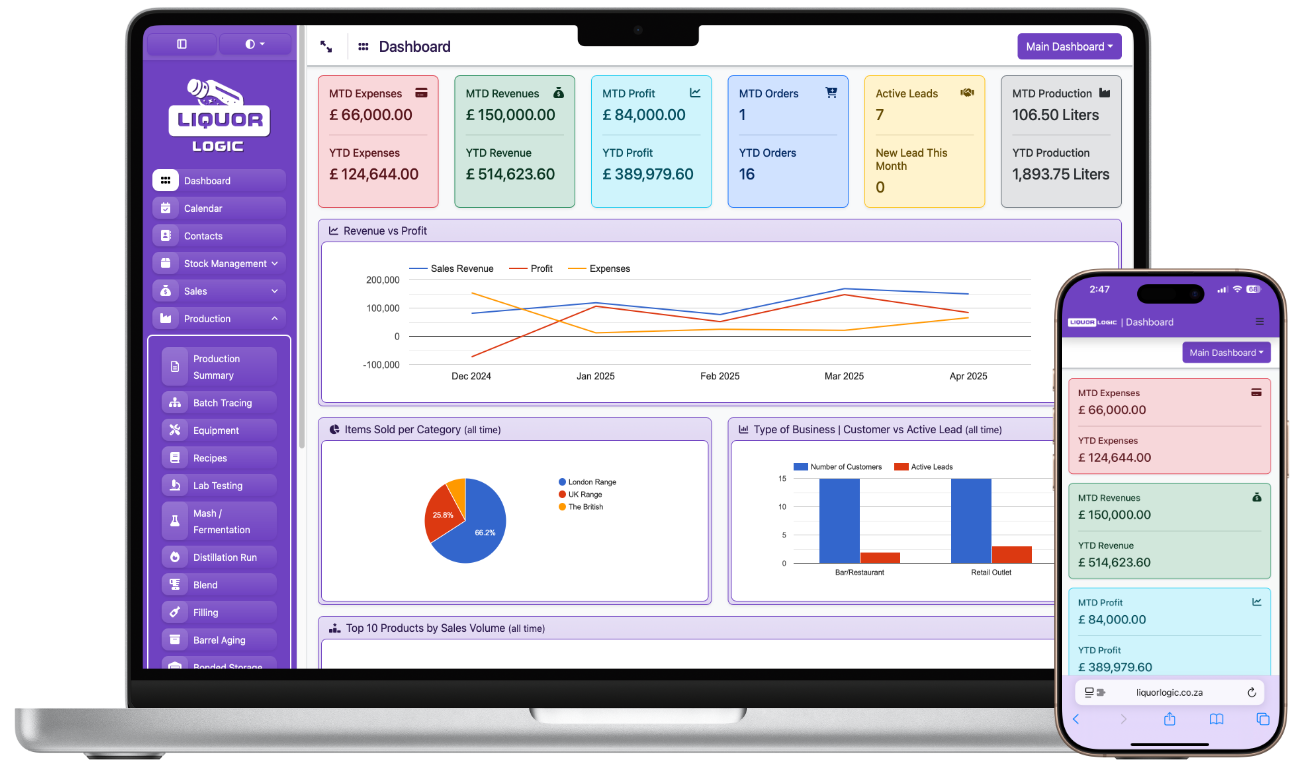
Excise duties and regulatory compliance are critical -- and often challenging -- aspects of alcohol production. Whether managing a winery, distillery, brewery, or cidery, failing to comply with local and national excise laws can result in severe financial penalties, legal exposure, and lasting reputational damage.
Understanding the Complexity of Excise Reporting
Excise laws vary by country and by product type, making compliance a moving target. Producers must account for:
- Different tax rates for spirits, wine, beer, and cider
- Production volumes and batch sizes
- Raw material inputs, yields, and losses
- Bonded storage, transfers, and contract production
- Detailed record-keeping for audits and inspections
Many producers still rely on manual spreadsheets or disconnected systems, which increases the risk of errors, submission delays, and costly penalties.
How Liquor Logic Simplifies Excise Management
Liquor Logic offers a comprehensive solution for excise reporting that removes the manual burden from compliance:
- Automated calculations: Duties are calculated automatically based on production volumes, batch types, and ingredient yields.
- Detailed excise breakdowns: Track spirits, beers, wines, and ciders separately, including intermediate products and by-products.
- Bonded storage management: Track storage locations, product transfers, and contract batches effortlessly.
- Historical reporting: Generate reports for audits or internal reviews without manual effort.
- Compliance alerts: Notifications for upcoming submission deadlines, discrepancies, or storage limit thresholds.
Best Practices for Accurate Excise Reporting
To ensure accuracy and full compliance, producers should:
- Implement end-to-end tracking from raw ingredients to finished goods
- Use software to calculate ingredient yields and batch losses precisely
- Maintain a centralised system that integrates production, inventory, and sales for seamless reporting
- Regularly reconcile actual inventory against production logs and storage records
- Train staff to understand excise requirements and the software workflows that support them
Example: Multi-Batch Distillery Operations
A distillery producing several spirits simultaneously faces significant challenges in calculating excise across overlapping batches. Liquor Logic simplifies this by:
- Assigning unique batch IDs and tracking each step of production independently
- Automatically calculating excise based on the exact spirit yield and alcohol percentage of each batch
- Generating submission-ready reports for tax authorities, including bonded storage details and transfer logs
- Providing real-time dashboards for management planning and forecasting
South Africa Specifically: What SARS Requires
South African alcohol producers operate under the Customs and Excise Act, administered by SARS. Key obligations include:
- Monthly excise account submissions on the prescribed DA 260 form
- Accurate production records from raw material intake through to final product removal
- Documentation of all losses -- evaporation, spillage, destruction, and rework
- Strict physical and record separation of bonded and duty-paid stock
- Full audit readiness at all times, with records available for inspection on request
Non-compliance carries serious consequences. SARS audits have increased in both frequency and severity, and producers whose records cannot withstand scrutiny face penalties, backdated assessments, and in serious cases, licence suspension.
Excise Reporting Questions Producers Ask Most
What is the difference between excise duty and VAT for alcohol producers?
VAT is a consumption tax charged at the point of sale to the end consumer -- the producer collects it on behalf of SARS and remits it. Excise duty, by contrast, is levied at the point of production or import and is the producer direct liability. You pay excise on what you produce, regardless of whether it has been sold yet. Both obligations run in parallel, which is why integrated software that handles both is considerably more efficient than managing them in separate systems.
How do production losses affect excise calculations?
SARS allows for certain production losses -- evaporation during fermentation and aging, unavoidable spillage, and product destroyed under supervision -- to be deducted from your excisable volume. However, these losses must be accurately documented and declared. Undeclared or poorly documented losses leave you exposed to assessments based on your raw production volumes without the offset. Liquor Logic records losses at every production stage and includes them correctly in your excise calculations.
Can excise software handle multiple product types in the same facility?
Yes -- and for most South African craft producers who make spirits, wine, or beer under the same roof, this is essential. Different excise rates, different reporting structures, and different bonded storage rules apply to each product category. Liquor Logic maintains separate excise tracking for each product type within a single account, generating consolidated or product-specific reports as required for your SARS submissions.
The Competitive Advantage of Getting Compliance Right
Excise compliance is not only a legal necessity -- it is a business advantage. Accurate, automated reporting allows for:
- Faster audits and inspections without operational disruption
- Improved cash flow by avoiding penalties and over-payments
- Better production planning and resource allocation
- A stronger reputation with regulators, distributors, and customers
Conclusion
Excise reporting and compliance in the alcohol industry are complex -- but fully manageable with the right tools in place. Liquor Logic provides a complete solution that enables wineries, distilleries, breweries, and cideries to automate calculations, maintain accurate records, and focus on growth and innovation while remaining fully compliant at all times.